Alligator Reef Lighthouse Shines Bright With Heroes and Superhumans Like Maximiliano “Maxi” Paccot in Its Corner
One lighthouse. Eight miles. A community determined to keep its light shining.
By Jorge Camaraza, Founder and President of Beyond Yacht Group
Yesterday morning, hundreds of swimmers entered the water at Amara Cay Resort in Islamorada for the 2026 Swim for Alligator Lighthouse.
The annual event is an eight-mile open-water race from Islamorada to Alligator Reef Lighthouse and back. It brings swimmers, kayakers, boaters and volunteers together to raise awareness for the restoration of one of the Florida Keys’ most recognizable maritime landmarks.
Four miles offshore, the lighthouse could be seen above the Atlantic. Reaching it, circling it and swimming back would require strength, discipline and determination.
Yesterday showed what can happen when athletes, boaters, kayakers, volunteers and community leaders rally around something worth saving.
Eight Miles Through Open Water
Solo swimmers and relay teams travel four miles to the lighthouse, circle it and complete the four-mile return. Each solo swimmer and relay team is accompanied by a support kayaker responsible for navigation, hydration and immediate assistance while safety boats monitor the course.
This is not for the faint of heart.
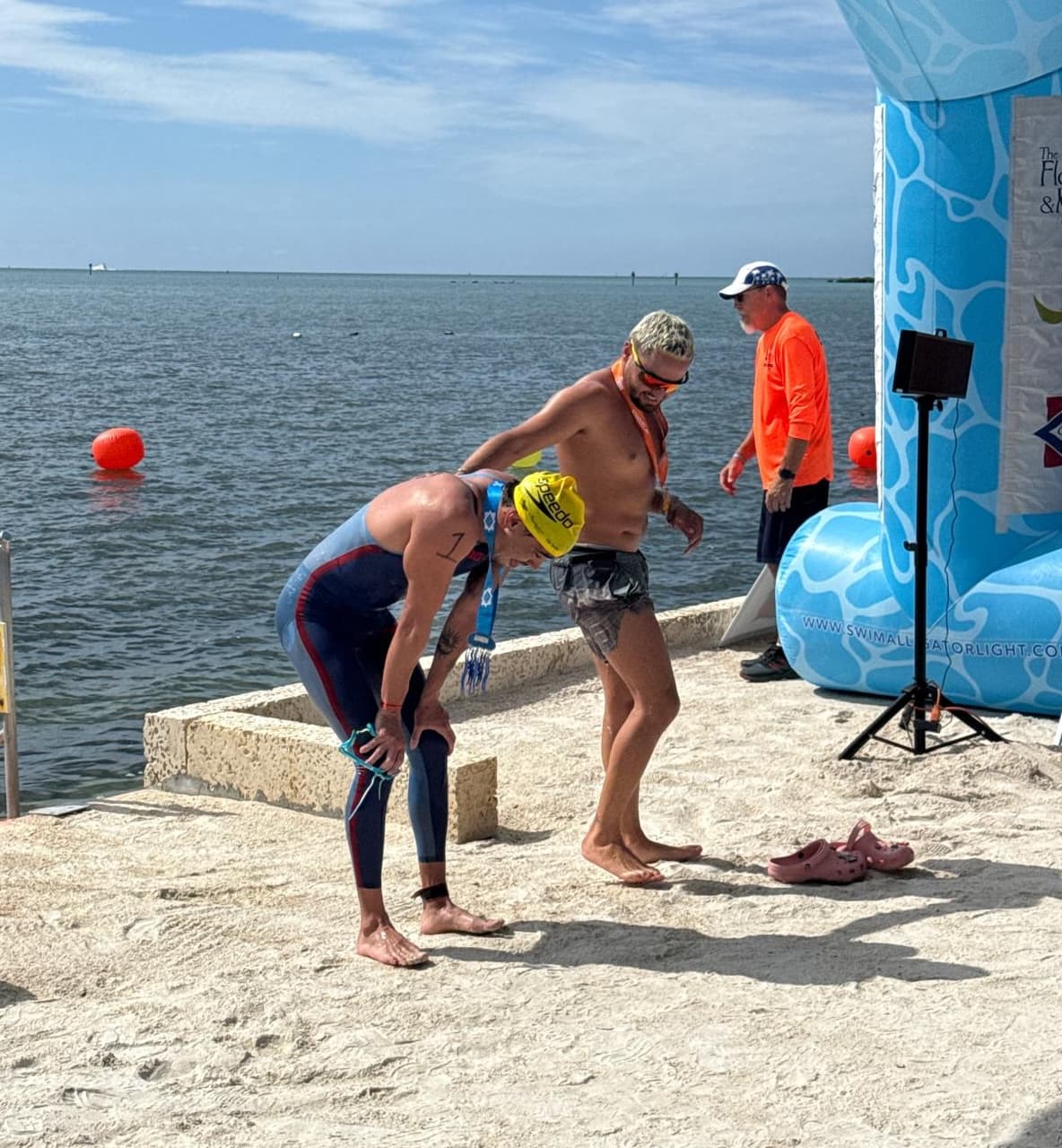
Paccot, an elite open-water swimmer from Uruguay, won the event in 2024 in 3 hours, 10 minutes and 30 seconds. He returned in 2025 and set a course record of 2 hours, 52 minutes and 18 seconds.
Yesterday, Paccot returned and once again emerged as the overall winner, completing the course in 3 hours, 4 minutes and 50 seconds.
The second-place finisher crossed the line in 3 hours, 44 minutes and 39 seconds, a whopping 39 minutes and 49 seconds behind Paccot.
Beyond Yacht Group had the privilege of supporting Paccot and his team. From the water, we watched the preparation and relentless pursuit required to compete at this level.
The Making of a Superhuman
The finish tells only a small part of Paccot’s story.
His weekly training can reach 60 to 70 kilometers. About one month before arriving in Islamorada, he completed a 32-kilometer swim in Canada. He is now preparing for a 57-kilometer race in Argentina.
This year’s preparation came with obstacles. Lightning interrupted several training sessions, and his original support kayaker canceled approximately one week before the race. A friend stepped in on short notice.
Paccot adjusted and kept moving forward.
He spoke about the importance of his family, friends and years of work with a sports psychologist. Behind his ability is mental discipline built through years of training, sacrifice and competition far from home.
The eight-mile swim is difficult.
The commitment required to make it look possible may be even greater.
The Lighthouse Behind the Race
In 2012, Florida Keys artist Larry Herlth, known as “Lighthouse Larry,” swam to Alligator Reef Lighthouse to bring attention to its deterioration. His effort inspired the organized Swim for Alligator Lighthouse in 2013.
First illuminated in 1873, the lighthouse takes its name from the USS Alligator, a United States Navy schooner that ran aground on the reef in 1822.
For more than a century, the 136-foot lighthouse warned mariners away from the dangerous reef. Although modern navigation replaced its original purpose, it remains one of the Florida Keys’ most recognizable landmarks.
It is part of the Keys’ history, identity and relationship with the water.
It is also in urgent need of restoration.
“It’s Not an If. It’s When.”
During the event, Beyond Yacht Group spent time with Lori LeBlanc, president of the nonprofit organization leading the restoration effort.
Friends of the Pool acquired the lighthouse from the federal government in 2021. Its next major milestone is restoring the detached platform beneath it.
Phase One will repair the supporting structure, install a new surface and create a gangway. The platform must be completed before construction boats can safely dock and unload materials.
When asked whether the organization would reach that milestone, LeBlanc corrected the question.
“It’s not an if. It’s when.”
That may be the best description of the people behind this mission.
Visiting Alligator Reef by Boat
Alligator Reef Lighthouse stands within the Alligator Reef Sanctuary Preservation Area. Boating, snorkeling and diving are permitted, but fishing and collecting marine life are prohibited.
Boaters should use an available mooring buoy, never anchor on coral and maintain a careful lookout for swimmers, divers and smaller vessels. During organized events, control your wake and give participants and safety crews plenty of room.
Learn more about the area and its regulations through the Florida Keys National Marine Sanctuary.
Why This Matters to Boaters
Those of us who spend time on the water know the Florida Keys are defined by more than coordinates and destinations.
They are defined by the reefs we navigate, the landmarks we recognize and the stories passed between generations of boaters.
I have a tremendous love for the Florida Keys. Supporting Paccot was an honor, but meeting the people working to save this lighthouse made the experience even more meaningful.
Paccot may possess superhuman endurance, but saving Alligator Light will require many hands, many voices and a shared commitment.
The lighthouse is a beacon. Its history, purpose and majestic presence merit a fight to protect and safeguard her future for generations to come.
Keep the light shining.
Learn more about the event at Swim for Alligator Lighthouse, support the restoration through Save Alligator Lighthouse or explore boats that are made to enjoy the Florida Keys with Beyond Yacht Group.
florida-keysboating-marine-conservation